Showing posts with label oxblood. Show all posts

Wednesday, September 16, 2009

Blooms from Autumn Rains

So we finally got a good, long, soaking wet. We've apparently received in the vicinity of 4 inches over the past two weeks. And when it hasn't rained, it's been overcast, which is wonderful too--highs in the 80s! I think it may really be Autumn (thank heaven!).

And suddenly, there are interesting plants all over the place. Pecans, it seems, are not the only ones to thrive on adversity.

Oxblood Fest
The most wonderful are the oxblood lilies (Rhodophiala bifida). Most of the oxbloods in my yard bloomed a week or two ago, presumably in response to the new watering system. But feral oxbloods around town seem to have been waiting for a proper rain, and now that they've got it, they're blooming with breathtaking ferocity. This is the best display I've seen since moving to Elgin. Actually, I think it's the best year for oxbloods that I've ever witnessed. I'm guessing it required the drought to retard the blooms and then a really good, long soak to make them all pop out at once.

The funny thing about oxbloods is that they are so long-lived and so retiring when not in bloom that people tend to forget they're there. So long after houses, flower beds, and walkways have been knocked down or moved, the oxbloods remain, faithfully marking those old features. And since most the houses in Elgin are old, you see a lot of oxbloods around, often rather haphazardly sprinkled around properties that were once very differently configured.


Older Elgin homes with scatterings of oxblood lilies
Mr. M's Oxbloods
One of the most impressive displays of oxbloods in Elgin (perhaps the second most impressive--the very best is on the eastern leg of Main Street, very near that yummy taco shack I mentioned a few posts back) is in our next door neighbor's yard. And they ought to be, I suppose; he's 90 years old. He's had time to let them grow and multiply.

Look at that lovely smear of scarlet. You'd think they were Dutch tulips, wouldn't you? I still think oxbloods should be planted in puddles and banks, not in straight lines, but for sheer volume and intensity of color, this is pretty impressive.

Mr. M's oxbloods

Look at that jubilant red!


Oxblood closeup

Mr. M's oxbloods (again)

Copper Lilies
For some reason, it is also a particularly good year for copper lilies (Habranthus tubispathus var. texensis), an orangy-gold rain lily. In our yard, we've have a number pop up all individually in the middle of the lawn, but other people have great drifts of them, like these folks below.

A drift of copper lilies

For a good closeup, check out this pic at Bayou City Heirloom Bulbs. They're shy, modest little flowers, but with very interesting coloring.

Or here's wikipedia's pic of a solitary specimen:*

Wikipedia's copper lily

And here's a nice little bank of them right opposite Meyer's BBQ.

Copper lilies on Hwy 290

Other Blooms
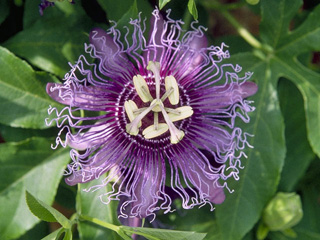
We've had some other very nice blooms in our yard lately. Here's another picture of that passionflower that I find so entrancing. I think it pairs very nicely with the deep pink of the "Maggie" rose, don't you?

'Dark Purple' passionflower and "Maggie" rose

And 'Buff Beauty' is blooming and growing all over the place. Finally. After two years of sulks. I do love these colors, though, so the wait was worth it.

'Buff Beauty'

*Come to think of it, I actually originally wrote that article on copper lilies in wikipedia. For some reason, the whole rain lily group was sadly underrepresented. But someone else supplied the image
.

Thursday, September 3, 2009

Fuzzy Morning Pictures

I was on my way out the door this morning when I saw this particularly lovely bloom on 'Souvenir de la Malmaison.' Work's been a bit tiresome lately, so I thought I deserved to take a few minutes this morning walking the garden and go in a little late. Timeliness is for drones.

This was a very nice thing in terms of seeing flowers as their first, freshest flush. It was not such a good thing in terms of taking photographs. Today's efforts are a sort of expressionist meditation on a flower garden in the middle of a late summer renaissance. (What exactly, you might ask, are the photos are meant to express? The deplorable effect of a lack of light on photographs, I think.)

Anyway, I'm abjectly sorry for the blurriness, but there's so much going on that I had to post them anyway.

For example, this blossom shows the distinctive, delicate coloring on S de la M: Palest pink petals with dark pink in the flower's interior.

A young 'Souvenir de la Malmaison' bloom. Apparently, in motion.

Also, these red lycoris (L. radiata) are in bloom. I don't have many of these bulbs, and they only bloom once a year (if that), so I had to snap while I could. These are in front of a trellis of 'Red Cascade.'


One of our very few Lycoris radiata plantings

Red lycoris and oxblood lilies bloom in the same general season, but I don't think they usually bloom at the exact same time. However, these are. Our yard seems to be in the peak of Oxblood bloom--perhaps hastened by the new irrigation system. The two pictures show the difference in color between these two somewhat similar amaryllids.

Oxblood lilies (Rhodophiala bifida) among the weeds & bananas

We've got a mysterious pink-striped crinum that's about to pop.

Unknown crinum buds

And this morning one of my 'Ellen Bosanquets' was rearing up proudly. Unfortunately, by evening the stalk had flopped over, as this particular specimen tends to do. Red-leaved crinum in the background.

The lilac-pink-and-apple-green buds of Crinum 'Ellen Bosanquet'

Our little 'Mlle. Franziska Kreuger' is covered in little pink balls. None of them are looking their best--all a bit spiky and scruffy, thanks to the weather--but as there are rather few pictures of Mlle. FK online, I thought I'd post this one.

'Mademoiselle Franziska Kreuger' tea rose during a drought

The Triumph of the Pecans
Meanwhile, our pecans are heavy with fruit. The old one in the front yard is to wieghed down that its branches are touching the ground in several places. And fat! I can't believe how big these pecans are. Where did the trees find the water to manufacture fruit so large? We gave them a few (very few) shots of water over the summer--but I can't think that 3 sprinkles with the hose could be transformed into much of anything. Goes to show what I know. I've got one of those pecan picker-uppers that looks like a slinky on a stick, so once they start dropping ripe ones, I'll start collecting.

Believe it or not, this thing is actually sold on amazon under the name "Pecan Picker Upper."

Pecan pralines, pecan tarts, pecan cookies, candied pecans, spiced pecans, pecan pralines... And this weekend I'm going to make pumpkin-pecan bars.

Fall's a-comin'!

Saturday, October 4, 2008

PORCH GLIDER!

We finally finished it! We've been working on it since February, and we finally got it done.

Ta-DA!
Completed porch glider in its new home by the patio

The rotten, rusty original came with the house, and we replaced the slats, the metal brackets, and all the hardware and painted everything. It's now go stainless steel bolts, red oak slats, and brackets made from hurricane fence pipes. It glides beautifully, it's wonderfully sturdy--it's altogether satisfactory.

And when we finished, we sat on our porch glider in the mellow, breezy, golden afternoon and just chilled. Exactly as I had planned.

View from our shade patio

Matt did most of the final work on the swing (I did help with the hacksaw, though. Sawing through fence pipe--not fun work). Meanwhile, with my trusty cultivator hoe--I love that thing--I slowly, carefully chipped the large mound of hard-backed earth from the buttress part of the cottonwood. Our tree guy was adamant that we needed to pull that soil back and let those buttress roots get air.

In the picture below, you can see the bit I had fully excavated on the right and the partially excavated side on the left. I think I gingerly dug off about 8 inches of soil.

And now I remember why I decided not to become an archeologist.

Partially excavated cottonwood

At the same time as all the swing/tree excitement was going on, one of our Oxblood lilies was blooming pink. I know that a pink subspecies or variety exists, but why didn't we see these last year? Do we have the true pink, or is it just some response to drought stress? Pretty, though, isn't it?

Pink Rhodophiala bifida (Oxblood lily)

And here are some picture of the cats. They are still pretty wary of each other (Po keeps getting in Izzy's personal bubble. Izzy doesn't like this. At all.) but no blood has been shed. And we only let them mingle under supervision. On the good news side of things, Izzy adapted to her litter box right away.

Po, whose gargantuan paws are twice the size of Izzy's.

Po's GlamourShot (TM)

Izzy, who sometimes looks shockingly sarcastic for such a young little kitty (1 to 1-1/2 yrs)

The Great Dictator

Matt and Izzy

Tuesday, September 16, 2008

Ode to the Oxblood

A clump of oxblood lilies (Rhodophiala bifida) growing on the shady side of the house

It's in the upper seventies, there's a very nice breeze, and the sky is blue--it's glorious weather. So I'm blogging from the front porch again. Still more oxblood lilies have popped up since yesterday, looking ever so lovely.

So let's ponder the oxblood.

The Oxblood in Context
Oxblood lilies look rather like slimmed down "Dutch" (South American) amaryllis because they are all members of the same family, the amaryllidaceae. So, like many other amaryllids, they are bulbs and they have six-petaled trumpet-shaped flowers and long, strap-like leaves. They also closely resemble the true (South African) amaryllis, Amaryllis belladonna, which, like the oxblood, blooms before its leaves emerge. Belladonna lilies, however, are pink, and have thicker stems and slightly larger flowers.

They're also a bit like some Cyrtanthus, an extremely varied South African genus that's not terribly common here in the US.

And they're probably most frequently confused with red spider lilies, Lycoris radiata. From a distance, they're both leafless, red, slim-petaled, and about the same height. However, spider lilies have thinner petals with wavy margins and, most importantly, long, spidery (hence the name) stamens that extend well beyond the flower and curl upwards.

The Oxblood in the Landscape
Oxblood lilies are members of the American genus Rhodophiala. Here in the US, we grow Rhodophiala bifida, but in Mexico and South America they have a treasure trove of different species. My favorite pictures of exotic Rhodophiala are by a guy named Hüdepohl. For example, see the golden Rhodophiala bagnoldii in a rather breathtaking desert landscape. Check out his unnamed pink amaryllid in a field of what appear to be bright indigo morning glory flowers. And I particularly love the Rhodophiala phycelloides, bright red on a vivid blue background. The dude knows how to take pictures.

Our little O. bifida looks comparatively modest, but it has its own virtues. In the old days (which old days? I don't know--those old ones) people planted oxblood lilies along their foundations, along sidewalks, and along fences and property lines. So rugged are they, that they will survive indefinitely on old abandoned homesteads, outlining buildings that have long since disappeared. (While I'm not sure that it's the best use of these plants, in Texas, oxblood lilies have a very linear identity. Our ninety-year-old neighbor, for example, has a big, fat double row of oxbloods along his fence line.)

I think clumping them near the front of a bed for little exclamation points of seasonal color is probably a better way to incorporate them into your landscape. We're puddling ours around a wee little bur oak, so hopefully we'll have a big pool of crimson some day. Admittedly, we're not there yet.

The beginnings of our colony of oxblood lilies

Oxbloods can take full sun, they (obviously) withstand drought, and they can handle at least some shade. Their bloom is brief, like most flower bulbs, but they're very dependable. And that deep crimson is so punchy.
Oxblood buds by the shade patio

Distinctive Features
Oxblood bulbs easy to recognize because they are sheathed in distinctive shiny, black, papery coverings ("tunics").

If I'm not mistaken, they've got something called "retractile roots," which are roots that first grow deep into the soil, then telescope in on themselves, pulling the bulb in after them. This is why you must be prepared to dig very, very deep if you plan to transplant a clump.

If you want oxbloods, though (and of course you do; who wouldn't?), transplanting is the way to go. They are only intermittently and unpredictably available in the nursery industry, and you often pay through the nose for the priviledge--rather like that other garden exellency, the crinum lily. The Antique Rose Emporium sometimes has them, and so, I believe, does the Southern Bulb Company, which uses a picture of oxblood bulbs for the rather stylish banner of their blog. We got lucky--our old farmhouse came well-stocked with venerable old plantings of the lovely things.

Closeup of an oxblood lily

Sunday, September 14, 2008

No Canned Salmon for Us

Well, we did have the fondue yesterday as planned, but nothing else went according to forecast. It was overcast all day, and we got a warm but vigorous wind, but as for rain, 50-mile-per-hour gusts, flooding, and other signs of the apocalypse--we got bupkes. I spent the entire day sitting on my front porch with my laptop, watching radar images of Ike slowly moving up, up, then over, over and away. Once--while I was turning on the irrigation system to water our drought-stricken plants--I felt a few tiny prickles that might have been rain drops. And that was it.

Filling up the upstairs tub with water was definitely overkill.

And the canned turkey? Matt suggested that if we'd been starving for 4 days, it probably would have tasted great. I'm not so sure. It's canned in water, so it has a bloated, gelatinous quality, rather like a drowned corpse. And it smells like cat food. We dipped a couple of pieces in the fondue, chewed reluctantly, and then Matt said, "Isn't there some leftover sausage in the fridge?"

Hurricane survival kit, now downgraded to all-purpose apocalypse survival kit. We'll be feeding the canned turkey to Po.

Fortunately, my Houston relatives fared nearly as well as we did. Mom & Dad's house sprang a leak, and there was some other less significant damage, but no flooding or tornadoes or downed trees or anything. And Mattchew & Bianca's brand-new house was fine. It has tons of windows that they had no time to board up, having closed on the house on Friday. Happily, these were unscathed.

Today was actually rather lovely up here in Elgin. A bit warm, but a nice breeze all day, deep blue September skies, and I finally did some stuff that needed to be done, which is rather satisfying. In defense of procrastination, I have to point out that finally doing these things wouldn't have been nearly as gratifying if I hadn't initially put them off until they weighed guiltily on my mind.

I planted a very lovely dark purple passionflower vine that we got from Grumpy Dave (the guy who runs Garden of the Ancients, this hippie commune-cum-nursery in northeast Austin, has a unique approach to customer service. He doesn't seem to get the rhythms of ordinary conversation, but, boy, get him started on the IRS--which he considers "treasonous"--or the outrages committed by cops, or the conspiray to silence Ron Paul, and he sure becomes voluble! And very, very indignant.)

This looks rather like the vine I bought from GD--I think it's Passiflora incarnata.

Anyway, I bought a particularly pretty, very dark purple passionflower from them. And now it's in the rose garden.

Here's why:

Distressingly huge empty blank space on our western wall

Our western wall looks all barren and mis-proportioned. It needs some sort of tall thing to join it to the ground. Hopefully, the 'Little Gem' magnolia at the front corner will grow in and take the edge off the edge, and the passionflower in the middle will make it all nicely tied together. Hopefully.

I also planted some dianthus by the front door in the two tiny little spots that I reserve for annuals. Not a big fan of annuals, generally, but I do make an exception for dianthus, especially dark red ones.

And I bought a couple more bags of decomposed granite to finish off the very end of the sidewalk. Happily, most of the stones do seem to have settled over time. The whole thing actually feels fairly solid. So apparently no special rock-settling skills are required after all.

I weeded the bur oak bed and gave it some more mulch. We didn't put any weed barrier down under that bed, and the bermudagrass has been popping up through the existing mulch like a fondue fork cuts through cheese (mmm... fondue...). However, it also has a bunch of oxblood lilies coming up. The yard had random OLs plopped in the middle of the lawn, in the shade bed, under the bananas--not good places for them. So last year we dug some up (and boy, was that ever a chore) and transplanted them. Huzzah for oxblood lilies!

The pioneers of our colony of oxblood lilies (Rhodophiala bifida)


I also gave a little mulchly love to our two most abused saplings: our Eve's necklace (Sophora affinis) and our pistache (Pistacia texensis--I think). While we were cherishing and mollycoddling the new baldcypress and magnolia and the invalid pear, these two scrawny orphans managed to cling to life with very little help from us whatsoever. As a reward, they each got an entire bag of fresh mulch to help fight back the ravenous bermudagrass.

And I sprayed Immunox. Credit to the toxic stuff: it seems to have staved off death (once again) for 'Wild Blue Yonder', which is not only alive, but even blooming the right color--a deep, jewel-tone magenta with a white eye. While it was out, I also spritzed 'New Dawn,' 'Autumn Damask,' 'The Fairy,' 'Lichterloh,' 'Belinda's Dream,' 'Mystery Pink Globes,' 'Mystery Red Pillar,' and 'Buff Beauty.' I don't think any of them really needed it (except the Red Pillar, which has a lesion I don't like the looks of), but it's been a rough year. They don't need black spot--let alone Horrid Fungus--on top of the general droughtly misery.

I also sprayed our 'Moonglow' Asian pear. There are some signs of infection right at my most recent cuts (I don't think I have to tell you that I dipped my pruners in alcohol between each cut, so I know the infection didn't spread that way). I'm hoping to control the problem with chemicals, since pruning is obviously not working for me. I'll continue spraying 'Moonglow' and WBY for the rest of the growing season. There is a point, however, at which they are both going to have to grow a pair and starting fighting off pathogens themselves. I'm hoping that by spring they'll both have stronger root systems, and that this will do the trick. As you know, I put great faith in root health.

In fact, I should probably look for some good root fertilizer for the entire garden this fall. Something nice and organic and yummy for the soil, ideally.


Related Posts with Thumbnails