Painting the mudroom reminded me that I wanted to organize my paint chips. At this point, most of the colors I used have been discontinued, so I'm including the codes, too, which (I hope) will still be in the computer at Lowe's if we need more. I scanned in the paint chips and used Photoshop's color dropper to paint each room. Worked well except for the whites, which didn't scan correctly at all.
In other news, it's hot. Gah. Hot, steamy, and sticky.
Field Trip to Finch's Farm
Also, Matt & I took a field trip to a little nursery on FM 1660 between Coupland and Rice's Crossing called Finch's Farm. We've passed it any number of times on the way to Hutto, but we never had time to drop in, and they're closed on Sundays.
Anyway, we finally made it over there, and it was actually much nicer than I had anticipated. It's bigger than it looks from the road, and it's the sort of small starter nursery in which the owner is happy to hang out and chat as long as you like. Since this kind of operation always makes me very curious, I take advantage of the opportunity to ask questions. I always want to know how business is, how long they've been open, how much of their own propagating they do...
This one has been open since 2001, I think, and has been growing gradually over the years. What I thought was really neat about Finch's is that he has a number of acres to play with, and he's using them to test his plants, especially trees. It's sort of like an extension agent's test garden. At the moment, most of his trees are smallish (maybe 4" in diameter?), but I love the idea. In addition to oaks and similar landscape trees, he has a few apples, peaches, walnuts, citruses, and, interestingly, olives in the ground.
Another reason I like visiting with small nursery owners is that you learn such interesting and random things. He gets his olives from an olive farmer south of San Antonio--who knew such a thing existed? He also knows of someone in Manor who has acres of olives, although he's only harvested 10 lbs so far. Again, who'd've thought? He also told us that he's had great luck with companionate planting of garlic amongst his peaches. Apparently, it's done a great job for him of keeping the insects off the fruit.
As a side note, he also raises bees, though he's not planning to harvest honey again till 2010--last year was apparently tough on the bees, and he wants to give them a break.
All in all, it seemed absolutely idyllic--acres to play with as your giant horticultural laboratory; room to dabble in other hobbies, like bees or chickens or goats or or quail; and (as he's a retired dude who is presumably doing this as supplemental income) the leisure to work as hard or as little as he likes. Since he inherited the land and got the greenhouses free, his financial risk is limited. And 1660 is really a very pretty road--farms, old houses, and hedges of trees. All in all, an enviable existence.
Awfully far from Central Market, though.
Bought an unlabeled plum-colored perennial from Finch's--must go plant it and my eggplants in the blue-and-purple garden (by the kitchen patio). It shall be a tranquil pool of indigo loveliness. Eventually.
PS--I hear thunder--perhaps we'll get some rain! I LOVE rain!
Showing posts with label nurseries. Show all posts
Saturday, May 23, 2009
Sunday, April 12, 2009
X Chitalpa tashkentensis 'Morning Cloud'
We finally bought that chitalpa at what is, from a tree-planting-in-Central-Texas perspective, more or less the 11th hour for 2009. I'd called around town 3 times before and no one had them in stock except Shoal Creek, for $58, which was a bit rich for my blood. Finally this past Friday--after another fruitless round of calling and a trip to Shed's, which promised me a chitalpa over the phone but only actually had a catalpa--I bit the bullet and went to SC. And even they only had one left in stock, although it was fortunately a good specimen.
A Rant
I had never thought chitalpas were all that rare, but when I'd ask for them, most nursery workers would say, "a what?" and "How do spell that?" or "Do you mean catalpa?" Very depressing. I always tell people to buy their plants at local nurseries because they (a) take better care of their inventory, (b) know what's actually adapted to the area, and (c) are much more knowledgeable than Lowe's/Home Depot/(God forbid) Wal-mart. (a) still holds. I was at Lowe's today, where they had slightly reduced the price on some mostly dead parlor palms that no one had apparently ever bothered to water--and that is absolutely characteristic. (b) and (c) though... I'm starting to wonder. I think it might be more fair to say that local nurseries are more likely to carry plants that are suitable to our climate. Sometimes they also carry fuschias and filberts. And while it's still true to say that they know more than big box employees, that particular bar is awfully low. Some local nursery workers are real experts--others, really, really not.
Incidentally, chitalpa (X Chitalpa tashkentensis) is an intergeneric hybrid of the extremely common desert willow (Chilopsis linearis) and Catalpa bignoniodes. I'd have been happy with one of those nice burgundy desert willows, but Matt finds them intolerably weedy. I don't know why the specific epithet is "tashkentensis"... okay, just googled--so named because it was hybridized in Tashkent, Uzbekistan. How about that?
Anyway, I bought the little fella--who, to be fair about the price, is a good 6' or more tall--and popped him in the ground today with some disreputable "cow manure" from Lowe's (only folks open on Easter) and a generous coat of mulch. It's a bit skinny for the moment, but I'm hoping it will fill out and nicely bracket the entire western side of the house.
The cultivar is not, Matt tells me, the one most commonly commercially available, 'Pink Dawn,' but is rather the less well known 'Morning Cloud.' We got lucky there, I think, as Pink Dawn is (surprise!) baby pink, while 'Morning Cloud' is white with maroon streaks. I'm not a huge fan of baby pink, so this is a good thing. And some websites say that MC is less susceptible to powdery mildew.
I also bought a Spanish lavender (Lavandula stoechas) for the herb garden, which is currently a pretty single-minded celebration of the rosemary (i.e., the only herb that hasn't died on us). Spanish lavender is supposed to be one of the toughest lavenders around, but they resemble rosemary in that they reach their breaking point rather abruptly, and once they're good and pissy, there's almost no recalling them to health. This worries me a little--I like plants that give you infinite second chances, like basil and spathephyllum.
Project Updates
We still have to do the fascia on the east side of the house, but progress has been made on the doors. I think we've got most of the paint out of the cracks of Flossie, Edith, and Poindexter. They still need to be sanded, and I think some spots may need another round of paint remover, but we did a big push last week and are now over the hump. Hopefully, we'll have Javier the Carpenter install them in June.
I also RoundUp'd today. Partly because some of the more stubborn weeds are having the temerity to poke their little heads through the 2 feet of expensive, deluxe mulch we laid down in the shade garden--and that's not on, as the British so adorably say--and partly in tribute to Mom's impending curtain-making visit. I'm ambivalent about RoundUp, which had damaged some of our roses (most notably 'Ferdinand Pichard') in the past (see example). To try to reduce unwanted drift this time, I cut the bottom out of one of our kitty litter buckets, placed it over the intended target, and then sprayed, hopefully shielding the nearby good plants.
Also, I've been working on installing the garden spotlights Mom & Dad gave us. We've got all the fixtures assembled and placed, and we (Matt) tunneled under the front sidewalk and installed a pipe to run the cable from one bed to the other, but we had to add on to the cable, and nothing downstream of the connection between the cables seems to be working. One half of the front yard is all illuminated and fancy looking, and the other half is black as Tartarus. Bother.
Saturday, February 28, 2009
Field Trip--Madrone Nursery
There is a nursery in San Marcos called Madrone Nursery that I've been meaning to visit for years. They specialize in native plants, but they're only open by appointment, so what with one thing and another, I'd never made my way down there.
I finally got my shit together this weekend, happily, and checked it out. And wow, the prices are good. His one-gallon perennials go for about $3.50! He's got a really big selection of trees, including some native oaks that are new to me, a weeping redbud, and a native crabapple that he's particularly proud of (sadly, Matt says I'm not allowed to buy any more trees--he doesn't think there's room. A needlessly defeatist attitude, I say.)
Madrone also has a number of nativey perennials, including a rare native Texas strain of Iris virginiana and the totally hip and unusual clover fern, which we first saw in the dinosaur garden at Zilker Botanic Garden.
The prices were so good, and there were so many things that would be striking and prolific, that I amassed quite the collection of pots. He's selling seedling Japanese maples for $25 for a 3 gallon. Because they're seedlings, if you buy them before they leaf out, you don't know if you're going to get charteuse, red, or purple leaves. In consideration of that fact, he gave me two for the price of one. So I paid $12.50 each for two 3-gallon Japanese maples! Holy cow! Those things usually sell for $50-$80! And they're a rare non-native exception in his inventory, but he's kept them because they grow so well, even in the limey soils and full sun of the hill country. They'll give a wonderfully eastern, lush quality to the bed. Every now and then, I'm filled with envy for those traditional southeastern plants that always look so graceful and elegant and faintly aristocratic to me: Flowering dogwood, Japanese maples, rhododendrons, mountain laurels, cherry trees... And now I'll have a little bit of Down East up here on the prairie.
I'm also particularly pleased about a couple of Dioon edules that I'm hoping will mimic ferniness without the tetchiness of actual ferns. The owner collected them on some limestoney mountain in Mexico that has comparable winter temperatures to Austin, so they should be cold-tolerant as well as alkaline-tolerant. They're also supposed to be resistant to some disease that's been affecting cycads in the east.
Here's the full list of my haul:
2 pint-sized satsumas (Citrus unshiu?)
1 slip of Iris virginiana (for which he charged me all of $1.00. Amazing.)
1 3-gal Mexican lime (Citrus aurantifolia)
2 3-gal Japanese maples (Acer palmatum)
4 1-gal Missouri violets (Viola missouriensis)
2 1-gal inland sea oats (Chasmanthium latifolium)
3 1-gal eastern columbine (Aquilegia canadensis)
1 1-gal Penstemon tenuis (which he gave me free on account of its being in the wrong area)
2 1-gal Penstemon digitalis
2 1-gal clover fern (Marsilea macropoda )
2 1-gal Dioon edule
1 1-gal cardinal flower (Lobelia cardinalis)
1 1-gal white boneset (Eupatorium havanense)
The owner is a real character. Not to the extent of Grumpy Dave, the Ron Paul-loving conspiracy theorist who runs Garden of the Ancients, locally renowned for its inventory of the hallucinogen Salvia divinorum. But the Madrone Nursery guy is clearly part of the spectrum of eccentric horticultural characters--he's full of opinions and interesting--even cliff-hanging--stories of the seedy side of the local hort biz. He's also very generous with his expertise and very willing to give tips and back story on his stock, most or all of which he has collected and propagated himself. He's a shotgun-toting anti-establishment environmentalist plant nerd and antiquarian. Apparently, after college he donated his peyote collection to Kew Gardens.
I've planted everything but the citrus in the shade bed, though I tried to give the clover fern a little extra sun. Will add pix tomorrow.
I finally got my shit together this weekend, happily, and checked it out. And wow, the prices are good. His one-gallon perennials go for about $3.50! He's got a really big selection of trees, including some native oaks that are new to me, a weeping redbud, and a native crabapple that he's particularly proud of (sadly, Matt says I'm not allowed to buy any more trees--he doesn't think there's room. A needlessly defeatist attitude, I say.)
Madrone also has a number of nativey perennials, including a rare native Texas strain of Iris virginiana and the totally hip and unusual clover fern, which we first saw in the dinosaur garden at Zilker Botanic Garden.
The prices were so good, and there were so many things that would be striking and prolific, that I amassed quite the collection of pots. He's selling seedling Japanese maples for $25 for a 3 gallon. Because they're seedlings, if you buy them before they leaf out, you don't know if you're going to get charteuse, red, or purple leaves. In consideration of that fact, he gave me two for the price of one. So I paid $12.50 each for two 3-gallon Japanese maples! Holy cow! Those things usually sell for $50-$80! And they're a rare non-native exception in his inventory, but he's kept them because they grow so well, even in the limey soils and full sun of the hill country. They'll give a wonderfully eastern, lush quality to the bed. Every now and then, I'm filled with envy for those traditional southeastern plants that always look so graceful and elegant and faintly aristocratic to me: Flowering dogwood, Japanese maples, rhododendrons, mountain laurels, cherry trees... And now I'll have a little bit of Down East up here on the prairie.
I'm also particularly pleased about a couple of Dioon edules that I'm hoping will mimic ferniness without the tetchiness of actual ferns. The owner collected them on some limestoney mountain in Mexico that has comparable winter temperatures to Austin, so they should be cold-tolerant as well as alkaline-tolerant. They're also supposed to be resistant to some disease that's been affecting cycads in the east.
Here's the full list of my haul:
2 pint-sized satsumas (Citrus unshiu?)
1 slip of Iris virginiana (for which he charged me all of $1.00. Amazing.)
1 3-gal Mexican lime (Citrus aurantifolia)
2 3-gal Japanese maples (Acer palmatum)
4 1-gal Missouri violets (Viola missouriensis)
2 1-gal inland sea oats (Chasmanthium latifolium)
3 1-gal eastern columbine (Aquilegia canadensis)
1 1-gal Penstemon tenuis (which he gave me free on account of its being in the wrong area)
2 1-gal Penstemon digitalis
2 1-gal clover fern (Marsilea macropoda )
2 1-gal Dioon edule
1 1-gal cardinal flower (Lobelia cardinalis)
1 1-gal white boneset (Eupatorium havanense)
The owner is a real character. Not to the extent of Grumpy Dave, the Ron Paul-loving conspiracy theorist who runs Garden of the Ancients, locally renowned for its inventory of the hallucinogen Salvia divinorum. But the Madrone Nursery guy is clearly part of the spectrum of eccentric horticultural characters--he's full of opinions and interesting--even cliff-hanging--stories of the seedy side of the local hort biz. He's also very generous with his expertise and very willing to give tips and back story on his stock, most or all of which he has collected and propagated himself. He's a shotgun-toting anti-establishment environmentalist plant nerd and antiquarian. Apparently, after college he donated his peyote collection to Kew Gardens.
I've planted everything but the citrus in the shade bed, though I tried to give the clover fern a little extra sun. Will add pix tomorrow.
Sunday, September 14, 2008
No Canned Salmon for Us
Well, we did have the fondue yesterday as planned, but nothing else went according to forecast. It was overcast all day, and we got a warm but vigorous wind, but as for rain, 50-mile-per-hour gusts, flooding, and other signs of the apocalypse--we got bupkes. I spent the entire day sitting on my front porch with my laptop, watching radar images of Ike slowly moving up, up, then over, over and away. Once--while I was turning on the irrigation system to water our drought-stricken plants--I felt a few tiny prickles that might have been rain drops. And that was it.
Filling up the upstairs tub with water was definitely overkill.
And the canned turkey? Matt suggested that if we'd been starving for 4 days, it probably would have tasted great. I'm not so sure. It's canned in water, so it has a bloated, gelatinous quality, rather like a drowned corpse. And it smells like cat food. We dipped a couple of pieces in the fondue, chewed reluctantly, and then Matt said, "Isn't there some leftover sausage in the fridge?"
Hurricane survival kit, now downgraded to all-purpose apocalypse survival kit. We'll be feeding the canned turkey to Po.
Fortunately, my Houston relatives fared nearly as well as we did. Mom & Dad's house sprang a leak, and there was some other less significant damage, but no flooding or tornadoes or downed trees or anything. And Mattchew & Bianca's brand-new house was fine. It has tons of windows that they had no time to board up, having closed on the house on Friday. Happily, these were unscathed.
Today was actually rather lovely up here in Elgin. A bit warm, but a nice breeze all day, deep blue September skies, and I finally did some stuff that needed to be done, which is rather satisfying. In defense of procrastination, I have to point out that finally doing these things wouldn't have been nearly as gratifying if I hadn't initially put them off until they weighed guiltily on my mind.
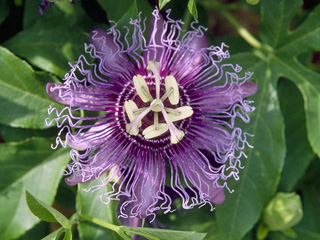
I planted a very lovely dark purple passionflower vine that we got from Grumpy Dave (the guy who runs Garden of the Ancients, this hippie commune-cum-nursery in northeast Austin, has a unique approach to customer service. He doesn't seem to get the rhythms of ordinary conversation, but, boy, get him started on the IRS--which he considers "treasonous"--or the outrages committed by cops, or the conspiray to silence Ron Paul, and he sure becomes voluble! And very, very indignant.)
Anyway, I bought a particularly pretty, very dark purple passionflower from them. And now it's in the rose garden.
Here's why:
Our western wall looks all barren and mis-proportioned. It needs some sort of tall thing to join it to the ground. Hopefully, the 'Little Gem' magnolia at the front corner will grow in and take the edge off the edge, and the passionflower in the middle will make it all nicely tied together. Hopefully.
I also planted some dianthus by the front door in the two tiny little spots that I reserve for annuals. Not a big fan of annuals, generally, but I do make an exception for dianthus, especially dark red ones.
And I bought a couple more bags of decomposed granite to finish off the very end of the sidewalk. Happily, most of the stones do seem to have settled over time. The whole thing actually feels fairly solid. So apparently no special rock-settling skills are required after all.
I weeded the bur oak bed and gave it some more mulch. We didn't put any weed barrier down under that bed, and the bermudagrass has been popping up through the existing mulch like a fondue fork cuts through cheese (mmm... fondue...). However, it also has a bunch of oxblood lilies coming up. The yard had random OLs plopped in the middle of the lawn, in the shade bed, under the bananas--not good places for them. So last year we dug some up (and boy, was that ever a chore) and transplanted them. Huzzah for oxblood lilies!
The pioneers of our colony of oxblood lilies (Rhodophiala bifida)
Filling up the upstairs tub with water was definitely overkill.
And the canned turkey? Matt suggested that if we'd been starving for 4 days, it probably would have tasted great. I'm not so sure. It's canned in water, so it has a bloated, gelatinous quality, rather like a drowned corpse. And it smells like cat food. We dipped a couple of pieces in the fondue, chewed reluctantly, and then Matt said, "Isn't there some leftover sausage in the fridge?"
Fortunately, my Houston relatives fared nearly as well as we did. Mom & Dad's house sprang a leak, and there was some other less significant damage, but no flooding or tornadoes or downed trees or anything. And Mattchew & Bianca's brand-new house was fine. It has tons of windows that they had no time to board up, having closed on the house on Friday. Happily, these were unscathed.
Today was actually rather lovely up here in Elgin. A bit warm, but a nice breeze all day, deep blue September skies, and I finally did some stuff that needed to be done, which is rather satisfying. In defense of procrastination, I have to point out that finally doing these things wouldn't have been nearly as gratifying if I hadn't initially put them off until they weighed guiltily on my mind.
I planted a very lovely dark purple passionflower vine that we got from Grumpy Dave (the guy who runs Garden of the Ancients, this hippie commune-cum-nursery in northeast Austin, has a unique approach to customer service. He doesn't seem to get the rhythms of ordinary conversation, but, boy, get him started on the IRS--which he considers "treasonous"--or the outrages committed by cops, or the conspiray to silence Ron Paul, and he sure becomes voluble! And very, very indignant.)
Anyway, I bought a particularly pretty, very dark purple passionflower from them. And now it's in the rose garden.
Here's why:
Our western wall looks all barren and mis-proportioned. It needs some sort of tall thing to join it to the ground. Hopefully, the 'Little Gem' magnolia at the front corner will grow in and take the edge off the edge, and the passionflower in the middle will make it all nicely tied together. Hopefully.
I also planted some dianthus by the front door in the two tiny little spots that I reserve for annuals. Not a big fan of annuals, generally, but I do make an exception for dianthus, especially dark red ones.
And I bought a couple more bags of decomposed granite to finish off the very end of the sidewalk. Happily, most of the stones do seem to have settled over time. The whole thing actually feels fairly solid. So apparently no special rock-settling skills are required after all.
I weeded the bur oak bed and gave it some more mulch. We didn't put any weed barrier down under that bed, and the bermudagrass has been popping up through the existing mulch like a fondue fork cuts through cheese (mmm... fondue...). However, it also has a bunch of oxblood lilies coming up. The yard had random OLs plopped in the middle of the lawn, in the shade bed, under the bananas--not good places for them. So last year we dug some up (and boy, was that ever a chore) and transplanted them. Huzzah for oxblood lilies!
I also gave a little mulchly love to our two most abused saplings: our Eve's necklace (Sophora affinis) and our pistache (Pistacia texensis--I think). While we were cherishing and mollycoddling the new baldcypress and magnolia and the invalid pear, these two scrawny orphans managed to cling to life with very little help from us whatsoever. As a reward, they each got an entire bag of fresh mulch to help fight back the ravenous bermudagrass.
And I sprayed Immunox. Credit to the toxic stuff: it seems to have staved off death (once again) for 'Wild Blue Yonder', which is not only alive, but even blooming the right color--a deep, jewel-tone magenta with a white eye. While it was out, I also spritzed 'New Dawn,' 'Autumn Damask,' 'The Fairy,' 'Lichterloh,' 'Belinda's Dream,' 'Mystery Pink Globes,' 'Mystery Red Pillar,' and 'Buff Beauty.' I don't think any of them really needed it (except the Red Pillar, which has a lesion I don't like the looks of), but it's been a rough year. They don't need black spot--let alone Horrid Fungus--on top of the general droughtly misery.
I also sprayed our 'Moonglow' Asian pear. There are some signs of infection right at my most recent cuts (I don't think I have to tell you that I dipped my pruners in alcohol between each cut, so I know the infection didn't spread that way). I'm hoping to control the problem with chemicals, since pruning is obviously not working for me. I'll continue spraying 'Moonglow' and WBY for the rest of the growing season. There is a point, however, at which they are both going to have to grow a pair and starting fighting off pathogens themselves. I'm hoping that by spring they'll both have stronger root systems, and that this will do the trick. As you know, I put great faith in root health.
In fact, I should probably look for some good root fertilizer for the entire garden this fall. Something nice and organic and yummy for the soil, ideally.
And I sprayed Immunox. Credit to the toxic stuff: it seems to have staved off death (once again) for 'Wild Blue Yonder', which is not only alive, but even blooming the right color--a deep, jewel-tone magenta with a white eye. While it was out, I also spritzed 'New Dawn,' 'Autumn Damask,' 'The Fairy,' 'Lichterloh,' 'Belinda's Dream,' 'Mystery Pink Globes,' 'Mystery Red Pillar,' and 'Buff Beauty.' I don't think any of them really needed it (except the Red Pillar, which has a lesion I don't like the looks of), but it's been a rough year. They don't need black spot--let alone Horrid Fungus--on top of the general droughtly misery.
I also sprayed our 'Moonglow' Asian pear. There are some signs of infection right at my most recent cuts (I don't think I have to tell you that I dipped my pruners in alcohol between each cut, so I know the infection didn't spread that way). I'm hoping to control the problem with chemicals, since pruning is obviously not working for me. I'll continue spraying 'Moonglow' and WBY for the rest of the growing season. There is a point, however, at which they are both going to have to grow a pair and starting fighting off pathogens themselves. I'm hoping that by spring they'll both have stronger root systems, and that this will do the trick. As you know, I put great faith in root health.
In fact, I should probably look for some good root fertilizer for the entire garden this fall. Something nice and organic and yummy for the soil, ideally.
Labels:
bulbs,
emergency prep,
nurseries,
oxblood,
roses
Subscribe to:
Posts (Atom)